
Personal Attention Seen As Antidote To Rising Health Costs
This story is part of a partnership that includes , and Kaiser Health News. It can be republished for free. (details)
Kevin Wiehrs is a nurse at a busy doctor鈥檚 office in Savannah, Ga. But instead of giving patients shots or taking blood pressure readings, his job is mostly talking with patients like Susan Johnson.
Johnson, 63, a retired restaurant cook who receives Medicare and Medicaid, has diabetes, and she already met with her doctor. Afterwards, Wiehrs spends another half hour with her, talking through her medication, exercise and diet.
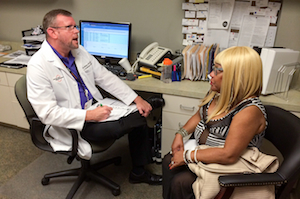
Care coordinator Kevin Wiehrs meets with patient Susan Johnson at Memorial Health, a medical system based in Savannah, Ga. (Photo by Sarah McCammon/Georgia Public Broadcasting).
鈥淪o it sounds聽like you cut back on your sweets, things that have a lot of sugars in them — what about vegetables, your portions of food, have you made any changes with that?鈥� he asks her.
鈥淎 little bit. Ain鈥檛 gonna lie; a little bit,鈥� she replies.
Wierhs, 51, was a hospice nurse for 15 years and a social worker before that. Now, he is one of five new care coordinators at Memorial Health, a medical system based in Savannah.聽 He was hired to pay special attention to patients with poorly controlled chronic conditions like diabetes and heart disease.
鈥淪ome of these patients have fought with their diabetes for many years and get very complacent with the whole situation and feel that no matter what I do it鈥檚 not going to make a difference. But it does,鈥� he says.
It鈥檚 hard to persuade people to change, Wiehrs says.聽 And patients are sometimes skeptical about his role in their care.聽 He says they often approach him and say, “I鈥檝e been coming to this office before; I鈥檝e seen these physicians. And now you鈥檙e somebody new. What are you doing, and why do you want to talk to me?”
Getting these patients to trust Wiehrs is an important part of the hospital鈥檚 strategy for dealing with rising costs. Memorial is investing $500,000 a year in care coordination, in the belief that the program will save money in the long run and improve the quality of care.
Memorial CEO Maggie Gill wants Wiehrs to teach patients to care for themselves.
鈥淵ou can help people prevent crises from happening by helping manage them outside the hospital,鈥� Gill explains.
She says Memorial provides about $30 million in free care each year. Because Georgia is not expanding Medicaid under the Affordable Care Act, Gill says the hospital is going to continue to give a lot of care for free to people who are low income and uninsured. On top of that, the federal government is penalizing hospitals if too many elderly patients with Medicare insurance have to be admitted repeatedly.聽 Wiehrs, Gill hopes, can prevent some of those repeat visits.
Gill recalls one Memorial care coordinator who had a particularly difficult diabetic patient.
鈥淸The patient] ended up in the emergency department typically two to three times a year,鈥� Gill says. 鈥淲ith the help of the care coordinator, the wife was now feeling comfortable in delivering insulin and measuring insulin levels, and they avoided at least two emergency department visits by having that resource.鈥�
On a typical day, Wiehrs meets with three or four patients and calls people who鈥檝e just been released from the hospital.
Wiehrs says patients end up trusting him. He makes sure they鈥檙e feeling good, taking their medication and that they know when to come in for a follow-up. He gives them his direct phone number so they don鈥檛 have to hassle with the front office. For those who can鈥檛 afford their medications, Wiehrs says he鈥檒l call drug companies or do research online to help find discount drug programs.
鈥淪ometimes you have to get creative and you have to spend the extra time to see what might be available,鈥� he says.聽 鈥淭hat鈥檚 the benefit of me being a care coordinator and having the experience that I have. I know how to navigate the health care system.鈥�
Wiehrs says he鈥檚 encouraged by the results he鈥檚 seeing already 鈥� like the patient who practically bounded into his office recently, breathing easier thanks to his new asthma inhalers.
The hope is that lots of little improvements like that will add up to big savings to the health system and healthier patients.


