
Influential Charity Applies Political Pressure To Win Hospital Approval On Third Try
This story was produced in collaboration with
With strict limits on medical facilities and equipment, Florida seems to set a high bar for building costly new hospitals. Among other criteria, organizations are required to show they wonā€™t duplicate existing services and drive up costs.
In 2006, regulators twice rejected applications from the Nemours Foundation to build a childrenā€™s hospital in Orlando, concluding it wasnā€™t needed. The area already had two large childrenā€™s hospitals, they noted. Adding another could fuel health inflation and hurt quality by cutting into the business at the existing hospitals.
But Nemours refused to accept no as an answer. The powerful Jacksonville-based health charity, one of the largest and richest in Florida, started marshaling political and civic support. Among benefits it touted was the economic impact of a new hospital, including thousands of high-paying jobs. Backers rallied around the plan, deluging the state capital with more than 1,000 letters of support.
ā€œNemours has an outstanding national medical reputation, and prodigious financial resources,ā€ the local League of Women Voters wrote.

Day TwoĢż
One City, Three Hospitals
Regional ReportsĢż
Arizona
Chicago
Denver
Ohio
Pittsburgh
Texas
Day OneĢż
The Rise of Children’s Hospitals
The two existing childrenā€™s hospitals opposed Nemoursā€™ plan. So, too, did some of Nemoursā€™ doctors, who left to join other hospitals. The Florida Health Care Coalition, an employer group aiming to lower health costs, also questioned the need for it.
ā€œThere is this idea in health care that if you build it they will come,ā€ said Becky Cherney, then head of the coalition. ā€œThatā€™s never a good thing in health care. Itā€™s very egotisticalā€¦and drives up costs.ā€ Ģż
But the appeal of childrenā€™s hospitals as caregivers for sick kids is powerful and unique. Even as regulators continued to say another childrenā€™s hospital wasnā€™t needed, they approved Nemoursā€™ plan in February 2008 to build a seven-story, $400 million childrenā€™s hospital and outpatient clinic complete with healing gardens and nature trails.
The story of how Orlando got a third new childrenā€™s hospital when most cities only have one is more than a tale of wealthy health care providers pressing their case. It is also about the pressures facing state regulators charged with restraining spiraling health costs. Attempts to limit expensive new hospitals, MRIs and other technologies have been under attack almost since the first laws requiring ā€œcertificates of needā€ were passed in the early 1970s.
In 2009,Ģż at a ceremony attended by then Gov. Charlie Crist, local politicians and civic leaders.Ģż
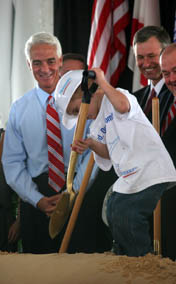
Gov. Charlie Crist attended the groundbreaking of Nemours Children’s Hospital in Feb. 2009 (Photo by Jason Greene/Orlando Sentinel).
Ģżā€œThe third time was the charm, I guess,ā€ said Richard Morrison, vice president of government relations for Florida Hospital, which operates a 200-bed childrenā€™s hospital in Orlando. ā€œThey spent a lot of money making their case, and they were effective doing it.ā€
After they gained approval, several Nemours officials contributed a total of $4,500 to the re-election campaign of state Rep. Dean Cannon, a Republican from Winter Park who helped to negotiate the final agreement with the state and other two childrenā€™s hospitals. A Nemours spokeswoman said at the time that its executives were free to support whomever they liked. Cannonā€™s office did not return e-mails or phone calls for comment.
Florida regulators declined to discuss their decisions in the Nemours case saying they didnā€™t have time for detailed questions. Nemours officials turned aside repeated interview requests to discuss why they insisted on building in Orlando instead of a less developed area of the state, or why they werenā€™t willing to merge their plans with one of the existing childrenā€™s hospitals.
In bond filings and other reports, Nemoursā€™ officials have said that they will be providing much needed care to a growing community. ā€œA key objective of the new hospital is to establish Central Florida as a leading health care region in the country through pediatric research, advocacy, and training,ā€ Nemours wrote as part of a $300 million bond offering to fund its new hospital.
Like most large, powerful nonprofits, Nemours has its own institutional ambitions. An internal vision statement notes that Nemours seeks to be recognized as one of the nationā€™s leading health care systems. In its various state applications, Nemours officials said they aspire to be ranked among the nationā€™s elite childrenā€™s hospitals.
The foundation serves as an umbrella organization for all of Nemoursā€™ health operations. In addition to the new Orlando childrenā€™s hospital, scheduled to open next year, Nemours owns and operates a 200-bed childrenā€™s hospital in Wilmington, Del., and several clinics. In 2009, the foundation reported $662 million in revenue, including $94 million from the $3.1 billion trust of the late industrialist Alfred I. DuPont, who directed his estate to create the charity.
Nemoursā€™ decision to build its own childrenā€™s hospital in Orlando evolved over time. In 1996 Nemours started to share its specialist physicians with the 160-bed Arnold Palmer Hospital for Children, named after the legendary golfer and benefactor. ā€œFor a number of years we worked really well with Nemours,ā€ recalled Arnold Palmerā€™s longtime CEO, John Bozard. ā€œIt was a real partnership. Some of our best physicians were from Nemours.ā€
But in the mid-2000s the relationship began to sour. Bozard said there were disputes over money, physicians and plans for a new hospital that Nemours and Arnold Palmer officials were discussing building together at the time.
ā€œThey never mentioned anything about a separate inpatient facility, Bozard recalled. ā€œBut things started to get strange after that. They wanted to negotiate everything.ā€
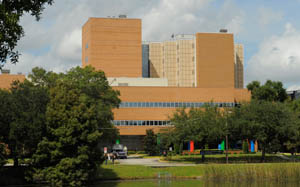
Arnold Palmer Hospital for Children first opened in Sept. 1989 (Photo by Scott A. Miller for KHN).
At one point, Bozard said, Nemours representatives offered to buy the Arnold Palmer Hospital. ā€œWe actually told them it was not for sale. They wanted to know if they could buy in as a partner. We told them we would entertain a 50-50 partnership. They turned that down. They said it had to be 51 percent.ā€
Cherney attempted to get the two sides to work out their differences, arranging meetings with doctors and top executives. ā€œWe said why donā€™t you two combine? Itā€™s supposed to be about the kids.ā€
After a while, the meetings collapsed. ā€œWhen you meet with docs it becomes a very egotistical thing, a turf war,ā€ Cherney said. ā€œThey both just said we canā€™t get along. We each have to be the boss.ā€
In 2005, Nemours informed Arnold Palmer that it intended to file a ā€œcertificate of needā€ with state health planners to build its own childrenā€™s hospital about four miles from downtown Orlando. Foundation executives stressed that their hospital would be devoted solely to children, unlike the other two hospitals, which are part of larger adult systems.
Executives of the two other childrenā€™s hospitals were upset by the proximity of the Nemoursā€™ site. They also said they were offended by the implication that Nemours would provide superior care. ā€œArnold Palmer and Florida Hospital are both large, well-respected childrenā€™s hospitals,ā€ Morrison said. ā€œIt turned into a slugfest after that.ā€
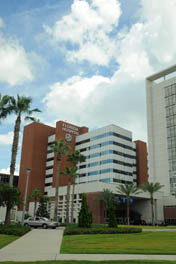
Florida Hospital in Orlando is part of a 2,188-bed hospital system with seven locations (Photo by Scott A. Miller for KHN).
The application was submitted to the Florida Agency for Health Care Administration in Tallahassee, where health planners reviewed it. TheĢż that the Orlando market already had a surplus of pediatric beds; the two existing childrenā€™s hospitals were operating below capacity and could accommodate future growth.
Most cities have enough children to support a single childrenā€™s hospital, said Larry A. McAndrews, until last week the head of the National Association of Childrenā€™s Hospitals and Related Institutions. ā€œThatā€™s what the market will support. There are exceptions. But Orlando stands out. I can see how people might have some questions.ā€
Undeterred, Nemours officials filed a second application. They stressed that their hospital would provide more complex, cutting edge care than the two other childrenā€™s hospitals. ā€œAmong the applicantā€™s expectations is being recognized nationally as a ā€˜top tierā€™ childrenā€™s hospital.ā€
There is no official top tier designation for childrenā€™s hospitals. The reference apparently was to an annual survey published by U.S. News & World Report ranking childrenā€™s hospitals according to selected criteria.
The state health planners noted that Nemours had operated the Alfred I. DuPont Hospital for Children in Delaware for decades without achieving an overall top ranking. They rejected the second application. ā€œNeed is not demonstrated,ā€ they wrote.
By this point, in 2006, Nemours officials had started to scramble. They initiated anĢż reaching out to politicians, civic leaders and media outlets.
They also set up a website and polled Orlando area residents, reporting that 95 percent of those surveyed favored their plan.
ā€œThere was a lot of community support because they were bringing in new money,ā€ said Morrison. ā€œIt was all about jobs.ā€
Nemours looked at a new location near the airport called Lake Nona. The site includes the University of Central Floridaā€™s new medical school, the Burnham Research Institute and a VA center. A new childrenā€™s hospital would nicely fit the vision of local politicians of making Orlando a medical destination.
ā€œNemours selected central Florida as the location for a new facility in order to participate in the regionā€™s development into a leader in medical care and research,ā€ Nemours said in a 2009 bond document.
Belle Isle Mayor William G. Brooks echoed that theme in a . ā€œWhat Nemours brings is not just more beds,ā€ he wrote, ā€œbut a global resource and name in medical research and treatment.ā€Ģż
Florida regulatorsĢż the hospital wasnā€™t needed. But this time they approved Nemoursā€™ plan, linking it to the larger efforts to develop Orlandoā€™s medical hub.ĢżĢż
ā€œA new administration had come in,ā€ Morrison said, referring to Crist. ā€œI think the new administration had a general attitude of more is better.ā€

The construction of Nemours Children’s Hospital is expected to finish some time next year (Photo by Joe Burbank).
The two other childrenā€™s hospitals challenged the ruling. But rather than fight a long, expensive legal battle, theyĢż in February 2008.Ģż Nemours officials agreed to a series of conditions, including not competing for two years with the other two childrenā€™s hospitals in the lucrative areas of open heart surgery, angioplasty and organ transplants. Nemours also agreed to provide much-needed mental health and rehabilitative care, and to accept a large number of patients with Medicaid.
Some question if the agreement will hold. The Orlando region has struggled in the recession, losing jobs and population. ā€œWeā€™re actually getting smaller,ā€ Cherney said. ā€œThatā€™s going to make it challenging.ā€
In order for Nemours to succeed, it will need to attract patients from across the state, not just the Orlando region, says Aaron Liberman, chairman of the health management department at the University of Central Florida. ā€œIf on the other hand they serve as a competitor for the same services provided by Florida Hospital or Arnold Palmer, then this could spell a real problem for all three institutions.ā€


