Stigma Is A Side-Effect Of HIV-Prevention Medicine
This story is part of a partnership that includes , and Kaiser Health News. It can be republished for free. (details)
In order to slow the spread of HIV, certain people who do not have the virus but are at risk should take medication to becoming infected. That鈥檚 the recommendation of the , and just recently, the .
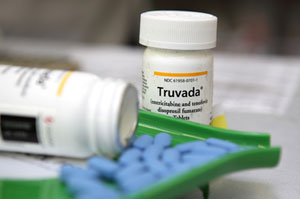
Bottles of antiretroviral drug Truvada are displayed at Jack’s Pharmacy in November 2010 in San Anselmo, California. (Photo Illustration by Justin Sullivan/Getty Images)
The preventive treatment includes a drug called Truvada, and it is known as PrEP, for pre-exposure prophylaxis.
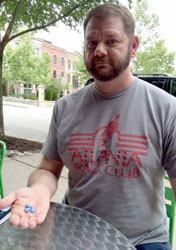
Eric McCulley made the decision to start PrEP. He鈥檚 40, he鈥檚 gay and he鈥檚 HIV-negative. Outside an Atlanta coffee shop, he pulls out a plastic baggy with a few blue pills.
“They鈥檙e a decent size, actually,鈥� he says. 鈥淪ome people might call them a horse pill.”
The treatment聽is a combination of two drugs that are also used to treat HIV.
After hearing about the treatment and doing extensive research on his own, McCulley consulted with his primary care doctor.
“He was very supportive about it. He encouraged me to do it,鈥� he says. 鈥淗e gave me a lot of stuff to read, gave me a lot of stuff to think about, and told me I was a good candidate for it. So off we went.”
A few months into treatment, McCulley says the only change has been is in his attitude.
“I have what I was looking for. 聽I have peace of mind.聽 I feel like I鈥檝e taken responsibility for my health,” he says.
But some PrEP users worry that not everybody in the medical community is up to speed.聽 Although Truvada has been on the market for a decade, have prescribing guidelines been available.
Listen to this story
Click below to listen to the accompanying NPR story:
Dylan West is a 25-year-old Atlanta resident and works in international aid.聽 He is also gay and recently found out first-hand that not every doctor is as familiar with PrEP as McCulley鈥檚.
Some gastro-intestinal issues recently landed West in the emergency department.聽 He鈥檇 started PrEP after beginning a relationship with someone who鈥檚 HIV-positive.聽 One of the doctors in the emergency room noticed West listed Truvada as a medication he regularly takes.
“She immediately, without asking any questions, just said 鈥榃ell, we should probably test for gonorrhea, syphilis, HIV/AIDS — the list,鈥� ” he says.
West feels that physician made a “rash assumption” about his sexual practices because he was on Truvada. West knew stigma was something he might face.
“The assumption being, you鈥檙e on Truvada, so you probably run around having sex with whoever you can,” he explains.
Some health advocates and activists within the lesbian, gay, bisexual and transgender communities have gone as far as to label those on PrEP as “Truvada whores.”
Dr. Melanie Thompson says she鈥檚 heard that before. She鈥檚 the principal investigator of the and has long worked in HIV research. She has encountered reluctance from some to prescribe PrEP because of lack of knowledge about it.
“This is an interesting thing to me,鈥� she says, 鈥渂ecause doctors who say, 鈥業 don鈥檛 want to prescribe PrEP to somebody who might be at risk for HIV because they might not use condoms.鈥� 聽You know, it鈥檚 an approach we wouldn鈥檛 take in other areas of medicine. “
Thompson says no doctor would refuse to prescribe cholesterol-lowering statins to patients because they鈥檙e overweight.聽 Somehow, the conversation around PrEP is different.
“So I think it鈥檚 a very interesting moralistic attitude that soon will be outdated.聽 But I do think that this is a barrier for some patients,鈥� Thompson says. 鈥淭hey feel stigmatized. And honestly, health care providers need to step up their game and do better than that.”
A CDC spokeswoman said that lack of awareness and knowledge among health care providers is one of the primary challenges to PrEP鈥檚 success.
But both Dr. Thompson and CDC officials hope the newly issued treatment guidelines will help overcome any barriers.


