
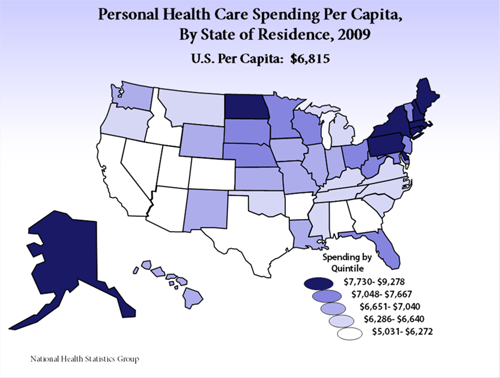
SOURCE: Population, U.S. Bureau of the Census; Spending, Centers for Medicare & Medicaid Services, Office of the Actuary, National Health Statistics Group
Updated Dec. 8, 2011 at 1:03 p.m.
Researchers at聽the office of the actuary and the Centers for Medicare and Medicaid Services聽offered of state-by-state health-care spending since the recession Wednesday, as well as a look at where provisions of the 2010 health law could have their greatest effect.
The authors of the research article, published in ,聽estimated per capita personal health spending for 2009 by state and found wide variation 鈥� from聽Utah鈥檚 74 percent of the national average of $6,815 per person to Massachusetts鈥櫬�136 percent.
鈥淲e鈥檙e seeing a broadening of the gap鈥� between higher- and lower-spending states, said Gigi Cuckler, a CMS economist and lead author, during a webcast by the Kaiser Family Foundation. (Kaiser Health News is an editorially independent program of the foundation.)
The analysis examined claims data from Medicare and Medicaid and extrapolated from that data to estimate overall spending. Researchers looked at 鈥減ersonal health spending,鈥� which they defined as medical spending that excludes administrative costs.
States with the largest per capita personal spending tended to have the highest personal income per capita, as well as older populations than average. Lower-spending states tended to have the opposite: lower personal income and younger populations. The latter also had lower rates of insurance coverage.
States with the largest per capita Medicare spending tended to have more female and African-American enrollees. The Medicaid data, which are complicated because of variation in state eligibility requirements, showed the lowest per capita spending in states with lower personal income.
Slowdown in spending growth 鈥� largely because of the recession 鈥� varied across states, too. Many of the states experiencing the largest slowdown had the largest increases in unemployment in recent years.
While the authors do not offer recommendations for the future, it does note that lower-spending states, with their larger uninsured populations, will likely have the most people in 2014 ready to enroll in coverage through state insurance exchanges or the expansion of Medicaid.
This story has been聽updated to remove references to a government 鈥渞eport.鈥澛營nstead,聽the information聽was published as a聽鈥渞esearch article.鈥澛�