BOSTON鈥揇r. Henry Feldman is a mobile technology evangelist. He struts boldly around Beth Israel Deaconess Medical Center, where he works as a hospitalist and programmer, armed with an iPhone and iPad. His nickname is the iDoctor.

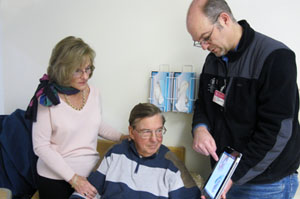
Dr. Henry Feldman, nicknamed the iDoctor, shows patient John Garrett and his wife Cheri photos and drawings of John鈥檚 recent surgery at Beth Israel Deaconess Medical Center (Photo by Jenny Gold/KHN).
Mobile technology, he argues, has made him a better, faster physician. 鈥淚t lets me do everything I could do if I was sitting at my desktop at the patient鈥檚 bedside, and actually some things I couldn鈥檛 easily do,鈥� he explains enthusiastically. That includes showing patients impressive new animated apps, diagrams, medical records and even photos from their own surgeries as they recover.聽
Beth Israel, a teaching hospital for Harvard Medical School, is one of the most technically advanced hospitals in the country, especially when it comes to mobile technology.
But not everyone at the hospital is quite as gung-ho as Feldman. Recently, , the hospital鈥檚 chief information officer who helped usher Beth Israel into the electronic world, has been issuing a warning: mobile technology also has a serious downside鈥攊t may distract doctors from patient care.
Doctors who carry mobile devices are often hit with a flurry of texts, e-mails, Facebook messages, tweets and other notifications that automatically pop up on the screen, he explains. And because the vast majority of smart phones and tablets are personal devices that belong to individual doctors, the problem can be hard for hospitals to control.

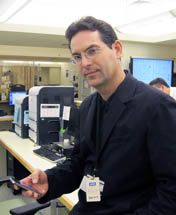
Dr. John Halamka in the emergency department of Beth Israel Deaconess Medical Center with his smartphone (Photo by Jenny Gold/KHN).
鈥淚 think all of us who use mobile devices have what I will call continuous partial attention,鈥� Halamka argues. 鈥淲e鈥檙e engaged in our work but at the same time we鈥檙e checking that e-mail or we鈥檙e glancing at that instant message.鈥� The distractions might be minor for people who work in a cubicle or a storefront, but for doctors, it can be a matter of life and death.
Distracting technology isn鈥檛 new for physicians鈥攁 pager, cellphone or computer can also divert a doctor鈥檚 attention. But at least 鈥渁 hospital laptop separated doctors鈥� personal and professional lives,鈥� explains Halamka, who is also the co-chair of a federal committee on health information technology. 鈥淲ith the bring-your-own-device trend, you see the blurring of that separation.鈥�
A doctor might be placing an order for a medication, for example, when 鈥渉ere comes a text from my spouse or a set of messages about something I鈥檓 going to do outside the office,鈥� says Halamka. Doctors tend to think they鈥檙e good at multitasking, he explains, but 鈥渨e may not know the errors we鈥檙e committing.鈥�
In December, Halamka wrote a聽 in an online publication produced by the federal Agency for Healthcare Research and Quality about an incident at another hospital. According to his report, a 56-year-old man was admitted from a nursing home to have his feeding tube replaced. A team of doctors at the hospital was making rounds and decided to stop giving him a blood thinner he was on, but as one of the residents was entering the new order into her smartphone, she got a text about a party. She was so busy RSVP-ing that she never completed the drug order. It wasn鈥檛 a small mistake; the patient required open-heart surgery and almost died.
鈥淚f you forgot to pick something up at grocery store, it鈥檚 an inconvenience,鈥� Halamka says. 鈥淚f you forgot to stop a blood thinner, it can result in significant harm.鈥�
To help prevent such an error from occurring at Beth Israel, Halamka has implemented policies advising doctors on how to minimize distraction on their mobile devices. The hospital is also experimenting with software products that separate the personal and professional functions of devices. He hopes to launch the new programs within the next six months.
The problem, he says, is that new technology fast outpaces the policies that aim to regulate its use.聽 鈥淭he consumer technology industry is bringing more tech to doctor hands faster than policy can be made,鈥� he explains, an experience that occurs outside of medicine as well.
鈥淗ow long did it take to pass laws against texting while driving,鈥� Halamka asks. 鈥淎nd we had how many people die because they were distracted drivers. There was a lag. I think maybe we鈥檙e at that point in health care.鈥�
础听 of 439 perfusionists, the medical technicians who operate heart-lung machines, found that more than 55 percent reported using their cell phones during procedures. Nearly 50 percent admitted texting, and 21 percent checked their e-mail.
Meanwhile, a聽 published in the Journal of Medical Internet Research found that smartphones significantly increase interruptions. Other聽 have shown that such disruptions are linked to an increase in clinical errors.
Jonathan Mack, director of clinical research and development at the West Wireless Health Institute, a San Diego-based nonprofit focused on lowering the cost of health care through new technology, says distraction from mobile technology 鈥渋s case by case, but it鈥檚 not a huge problem overall.鈥�
鈥淚t鈥檚 a learning curve鈥� as hospitals adapt to the new technology, he says. In the meantime, hospital administrators should be comfortable calling doctors on bad behavior if they see it and offer training on how to use the devices so that they don鈥檛 become a barrier to care.
But , the iDoctor, says that of all of the distractions he faces as a physician at Beth Israel, mobile technology is the least concerning, especially compared to the human distractions of nurses, patients and interns.
鈥淯nlike my mobile technology, which I can shut off and not pay attention to, I can鈥檛 not pay attention to the nurse who鈥檚 directly in front of me,鈥� Feldman says. 鈥淪hutting off nurse is a quick career-ending move around here.鈥�