President Obama is moving quickly to head off opposition to major health care legislation from fiscal conservatives in Congress by vowing to follow strict rules for paying for it without further driving up the already huge deficit.
With the country mired in a deep recession and the government headed for a $1.8 trillion budget gap this year, deficit hawks say it would be irresponsible to commit from $1 trillion to $1.5 trillion for expanded health care coverage in the coming decade, as the president and many in Congress appear braced to do. A new Gallup survey shows the public divided over Obama鈥檚 handling of the budget deficit, with 48 percent disapproving and 46 percent approving

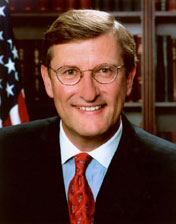
Sen. Kent Conrad, D-N.D.
Over the past week, the president has vigorously wooed so-called Blue Dog Democrats and other party conservatives with proposed rules that would force the government to pay for expanded health care now, rather than putting it off until the distant future.
鈥淓ntitlement increases and tax cuts need to be paid for,鈥� Obama said yesterday, as he invited dozens of conservative Democrats to the White House to discuss his approach. 鈥淭hey鈥檙e not free, and borrowing to finance them is not a sustainable long-term policy.鈥�
But strong doubts persist about the impact on the deficit of extending health care coverage to 46 million uncovered Americans, and budget hawks on the Hill may yet throw up roadblocks. The major risk for Obama and his allies in Congress: that the legislation is drastically scaled back to reflect uncertainty over future funding, with at most a watered-down government-sponsored insurance plan to compete with the private sector.
Meanwhile, House and Senate Democrats pushed their reform plans ahead. Democrats on the Senate Health, Education, Labor and Pensions Committee released their health care proposal yesterday, but left out for now the two elements Republicans dislike the most 鈥� a government insurance plan and a requirement that employers provide coverage. The bill will be discussed at a committee hearing tomorrow.
The chairman of the three House panels drafting health care legislation briefed House Democrats on their bill, which includes requirements that both individuals and employers purchase health insurance, a government-run plan and an insurance 鈥渆xchange鈥� to help individuals and small employers purchase coverage.
Senate Budget Committee Chairman Kent Conrad, D-N.D., a skeptic of the government鈥檚 ability to pay for a massive expansion of the federal health care program, complained to reporters that there were $3.5 trillion worth of loopholes in Obama鈥檚 latest spending-control plan. Others gave more cautious reactions.
鈥淥bama has taken a step in the right direction, in terms of pay as you go and watching spending, so I鈥檓 encouraged by that,鈥� said Sen. Ben Nelson, D-Neb., a leading Democratic fiscal conservative on Capitol Hill. 鈥淏ut there鈥檚 a lot to be done . . . and I鈥檓 anxious to see what the details are and what he hopes to put on the line.鈥�

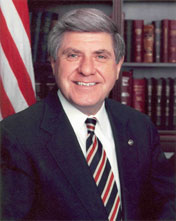
Sen. Ben Nelson, D-Neb.
On the House side, the combination of yesterday鈥檚 White House announcement and a presidential letter to two Senate committee chairmen last week 鈥� promising to pay for the health care program in real time, with real cuts and tax revenues, instead of simply adding to deficit spending 聳 got a warm reception from some Blue Dog Democrats.
鈥淗e laid down the law that it had to be deficit neutral,鈥� said Rep. Jim Cooper, D-Tenn., a leading Blue Dog member. 鈥淗e鈥檚 as serious as a heart attack about this . . . and all the signals I get from the White House is that this is non-negotiable.鈥�
The group of 51 fiscally conservative and moderate 鈥淏lue Dogs鈥� could have a major say in the final shape and price tag of the legislation. That鈥檚 because the administration would need two-thirds of the coalition members to pass a bill in the House without any Republican support, a growing possibility in light of Republican opposition to creation of a government insurance entity and imposition of employer mandates to provide insurance.
Some Democrats remained wary about the costs. 鈥淲e need to be cognizant of how much we spend,鈥� said Rep. Mike Thompson, D-Calif. 鈥淲e have a situation where for the last eight years spending has been absolutely out of control, with no consideration for what it鈥檚 going to do to future generations. We have to be diligent in resolving the [health care] problem, but also doing it in such a way that we don鈥檛 break the bank.鈥�
Rep. Gabrielle Giffords, D-Ariz., said that more than 1,000 residents turned out for a recent health care town meeting in her district, and that 鈥渃ost is something that was consistently brought up.鈥�
While Obama and Democratic congressional leaders appear on a fast track to enact legislation by early fall, budget watchdog groups are urging caution.
鈥淭hey could just end up adding to the government鈥檚 commitments without doing any serious cost control,鈥� said Robert Bixby, executive director of the Concord Coalition, which advocates a balanced federal budget.
Maya MacGuineas, president of the Committee for a Responsible Federal Budget, cautions Congress against creating a new entitlement program when the government is struggling with the cost of Medicare, the federal program for the elderly, and Medicaid, the state-federal program for the poor.

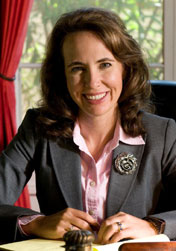
Rep. Gabrielle Giffords, D-Ariz.
鈥淲e should slow the growth of health care and close the Medicare deficit before expanding health entitlements,鈥� she said.
The prospect of a new health insurance entitlement program on the heels of a banking and auto industry bailout and a $787 billion stimulus package is a hard sell to fiscal conservatives. But Obama, White House Chief of Staff Rahm Emanuel and other administration officials have worked hard to disarm potentially nettlesome Democratic lawmakers.
Early on, Obama courted moderate to conservative Democrats in the Senate with the argument that Congress couldn鈥檛 afford not to pass major health care legislation this year, regardless of the short-term cost. Huge health care savings could be realized in coming decades, administration officials say, and that would eventually begin to drive down the deficits.
Obama and his budget chief, Peter Orszag, also claim that the new health care program would be 鈥渄eficit neutral,鈥� meaning additional costs would be offset by health care spending savings and new revenues.
But many were skeptical of the administration鈥檚 claim it could achieve a large part of those savings through trendy health care innovations, such as health information technology, better research into the effectiveness of new treatments and greater focus on prevention of illness. Indeed, the Congressional Budget Office, once headed by Orszag, dismissed many of those projected savings as pie in the sky.
Last week, however, Obama promised in his letter to the two senators that the government would pay for the program as it goes along, instead of simply adding to deficits.
鈥淗ealth care reform must not add to our deficits over the next 10 years 鈥� it must be at least deficit neutral and put America on a path to reducing its deficit over time,鈥漢e said in the letter to Senators Kennedy, D-Mass., chairman of the Health, Education, Labor and Pensions Committee, and Max Baucus, D-Mont., chairman of the Finance Committee.