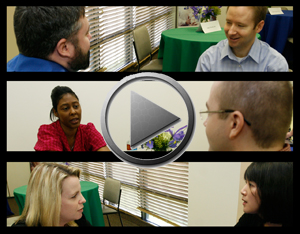
View Slideshow
: Speed Dating For Doctors

BEDFORD, Texas 聳 It鈥檚 Tuesday afternoon, and time for speed dating to begin 聳 at a local hospital near Dallas.
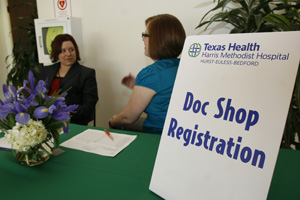
Twenty people 聳 parents needing pediatricians and doctors looking for patients 聳 are gathered for the event in a meeting room that looks like a caf茅, with colorful tablecloths and vases of lilies. At each table, a local pediatrician is waiting to meet with his or her 鈥渂lind date.鈥� The program works the same way as romantic speed dating, but here, the hospital is hoping to make a match between physicians and patients. It鈥檚 a tool to recruit doctors 聳 critical drivers of revenue 聳 and consumers.
Physicians and parents pair off for five minutes, then rotate into new conversations.
鈥淗ow far along?鈥� Dr. James Wheeler asks Kim Gage, a 37-year-old computer programmer pregnant with her third child, as she approaches his table. 鈥淚 usually am not too cavalier about that question, but I thought I was safe here.鈥�
Listen To Related Audio
鈥淵ou are safe here,鈥� Gage replies with a laugh. The two seem at ease, and Gage peppers him with questions. How accessible would he be as a doctor? How does he feel about medications for attention deficit disorder? And what does the office look like?
The 鈥淒oc Shop,鈥� the fifth at the Texas Health Harris Methodist Hospital Hurst-Euless-Bedford, is an innovative example of hospital marketing.
Although some critics say marketing drives up the cost and use of health care, many in the hospital industry say it鈥檚 crucial in the face of increasing competition, which includes not only other hospitals but also private operations such as surgical and imaging centers. In addition, they say, much of hospital marketing is geared to educating patients and physicians about the hospital鈥檚 quality and services.
Million Dollar Budgets
The dollar amount that hospitals spend on marketing and communications doubled during the past decade. In 2009 the budgets ranged from an average of $1.3 million for independent hospitals to $5.8 million for large health systems, according to a survey by the Society for Healthcare Strategy and Market Development (SHSMD), part of the American Hospital Association. That鈥檚 less than one percent of the average hospital budget and may also include money spent on free screenings at health fairs and publication of hospital magazines.

But with more people losing employer-based insurance and some skipping elective procedures, revenue declined during the economic downturn.
By advertising for free on Facebook, Twitter and e-mail, Texas Health HEB marketing specialist Mandy Forbus says the hospital was able to keep the cost of the Doc Shop at about $600. And she鈥檚 able to target a specific population of patients, many of whom are privately insured.
Hospital President Debbie Paganelli says the Dallas-Fort Worth area is 鈥渉ighly competitive鈥� for hospitals, with several major health systems in a relatively small area. 鈥淚鈥檓 always going to be looking over my shoulder to see what [the] competition is doing because I always want to stay one step ahead of them,鈥� she says. That includes staying on top of cutting-edge technology, constantly renovating the facility as well as marketing campaign.
The first four Texas Health HEB Doc Shop events, which began last fall, were aimed at OB-GYNs. Paganelli explains that much of the marketing is targeted toward women, who make many of a family鈥檚 health care decisions.
Targeting Doctors
The Doc Shop is not just about marketing to patients. It鈥檚 also a tool to reach out to physicians and encourage them to refer their patients back to the hospital.
鈥淧hysicians drive health care, period,鈥� says Travis Singleton, a senior vice president at Merritt Hawkins, a physician placement firm. 鈥淣inety percent of the health care dollars that are spent in today鈥檚 marketplace are through the physician鈥檚 pen, whether that鈥檚 patients they admit, whether that鈥檚 tests they administer, whether that鈥檚 procedures they order, whether that鈥檚 insurance they bill.鈥�
Even if a Doc Shop participant chooses one of the physicians at the event, there鈥檚 no guarantee that the hospital will ever see any business from them. But when hospitals help doctors, the business often trickles back over time in 鈥渄ownstream revenue鈥� with referrals for surgeries, tests and other procedures, Singleton explains. 鈥淎s a hospital, if you鈥檙e trying to run your business in the most efficient and financially viable way possible, you need to make sure you have the most physician-friendly environment where they feel comfortable,鈥� he says.
Dr. Rebecca Guinn, a young OB-GYN who began practicing last August, has attended three of the Doc Shops so far and says she鈥檚 gotten at least 10 new patients through the events.
鈥淚t鈥檚 a great service the hospital is providing,鈥� says Guinn, who delivers her patients at Texas Health HEB. Not only has it helped grow her practice, but it鈥檚 also helped to ease what could be an awkward first office visit. 鈥淚t feels like a more friendly encounter. They鈥檙e more relaxed and ready to talk.鈥�
鈥淚 Can鈥檛 Say: 鈥榃e Have a Sale On Appendectomies鈥欌��
Susan Dubuque, president of Neathawk Dubuque & Packett, a marketing firm in Virginia, says hospital marketing can be challenging. Unlike retail, she explains, health care is episodic. A clothing shop, for example, can advertise a sale on dresses, but 鈥淚 can鈥檛 very well do a sale and say 鈥榳e have a sale on appendectomies today,鈥欌�� she explains.
Nonetheless, there are a number of strategies to help consumers think of the hospital if a medical need arises. Sometimes, a hospital might advertise an elective procedure, such as a gastric bypass, but generally, hospitals work to build up their brand over time. 鈥淵ou never know when the need will arise for any individual patient for a health care service,鈥� says Dubuque, who is also an SHSMD board member.

A hospital might advertise an expensive new piece of technology or robotic surgery, for example. Even if the people who see that ad never need a procedure that requires the equipment, it 鈥済ives them the sense of confidence that this place has latest and greatest,鈥� she explains. 鈥淚f you can do high-tech procedure, surely you can take care of my gall bladder.鈥�
James Unland, editor of the Journal of Healthcare Finance, says many hospitals overreach with their marketing, too often targeting audiences that are outside their geographic area and failing to take into account that doctors generally determine where a patient is hospitalized. But he says concentrated efforts, especially those aimed at educating patients, such as Website use of interviews with doctors or virtual tours of facilities, can be helpful and very cost effective.
For patients, living in a competitive hospital marketing environment can mean access to perks like newly renovated hospitals, free lecture series and magazines and, for those in Bedford, Texas, help choosing a new physician.
Kim Gage says the speed dating event was a success: it helped her find Dr. Wheeler, the pediatrician she鈥檚 been searching for. 鈥淢eeting them and getting a feel is so much better than picking a name,鈥� she said. 鈥淚t didn鈥檛 take long, you got free lunch and you got to meet the doctors! There鈥檚 nothing bad about it.鈥�