
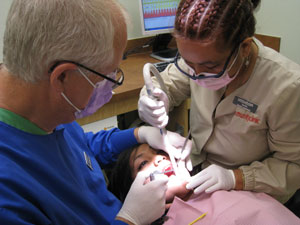
A Marshallese teenager gets her molars sealed at the dental office of St. Francis House in Springdale, Ark., a community health clinic that sees about 1,000 Marshallese patients a year. (Jenny Gold/KHN)
SPRINGDALE, Ark. 鈥� Here in the self-described 鈥淐hicken Capitol of the World,鈥� an enclave of unlikely migrants 鈥� 6,000 people from the Marshall Islands 鈥� is watching the health care debate with heightened interest.
Under an accord negotiated two decades ago involving three Pacific Island nations, the Marshallese can travel and work freely in the U.S. But many have low-paying jobs and high numbers are uninsured.
Years ago, they were eligible for immediate coverage under Medicaid, the federal-state health insurance program for the poor, but that benefit was revoked in 1996 as part of welfare reform. The result is they aren鈥檛 eligible for Medicaid 鈥� even after the five-year waiting period that applies to most other immigrants.
Related Audio
That鈥檚 unfair, say advocates who argue that the Marshallese are contributing to the American economy by working and paying taxes and should have the same access to government programs as other legal immigrants. 鈥淚t鈥檚 like going to a party and you鈥檙e bringing your potluck dish of rice and fried chicken and fried fish, but you鈥檙e not eating anything,鈥� said Marshallese Consul General Carmen Chong.
Now, the health care legislation being debated in Congress might provide some relief. Under the House bill, a little-noticed provision sponsored by Rep. Neil Abercrombie, D-Hawaii, would restore the migrants鈥� eligibility for immediate Medicaid coverage. The Senate bill doesn鈥檛 have a similar provision.

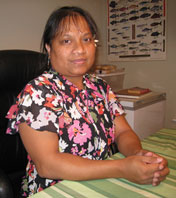
Consul General Carmen Chong Gum sits in the kitchen of her home in Springdale, Ark. Gum says the Marshallese work and pay taxes in the U.S., and therefore should have the same access to government programs as everyone else. (Jenny Gold/KHN)
Besides the Marshallese, the House provision also would apply to migrants from the Federated States of Micronesia and the Republic of Palau. The three strategically located archipelagos about 2,000 miles southwest of Hawaii, came under U.S. control following World War II as part of a United Nations-designated trust. The U.S. created military installations in the region and used several of the Marshall Islands as nuclear test sites.
The three nations received their independence in the 1980s and agreed to host U.S. military facilities. In exchange, their citizens are allowed to work in the United States without a visa.
Rough estimates suggest there are about 20,000 islanders from the three countries living in the U.S., mostly in Hawaii. There are no estimates of how many are uninsured.
On a recent Wednesday night, about 50 Marshallese gathered at King鈥檚 Chapel for a rock-and-roll prayer service. Waston Attari, 40, sat in the front row, poring over a bible. He says sometimes the American dream feels more like a myth. 鈥淟iving in the U.S. is a challenge for every one of us,鈥� he says. He described many in his community who are living paycheck to paycheck.
For Attari, the most difficult part has been getting health care for his diabetes. He鈥檚 a self-employed tax adviser and doesn鈥檛 have health insurance. A community clinic has helped him get free insulin, but he explains that he can鈥檛 go to a doctor 鈥渂ecause I don鈥檛 have the money to pay for the bills.鈥� He believes he would qualify for Medicaid services under the legislation and could see a doctor regularly.

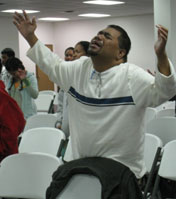
40-year-old Waston Attari lifts his arms in prayer during a Wednesday night service at King鈥檚 Chapel in Springdale, Ark. Attari, a diabetic, cannot afford private insurance and does not qualify for Medicaid because he is Marshallese.(Jenny Gold/KHN)
Many Marshallese are offered health insurance through the poultry plants. At Tyson鈥檚 Chicken, for example, a family health insurance plan costs about $120 a month. But Sandy Hainline Williams, a county health worker, says few Marshallese can afford that.
Williams explains that 20 of the migrants might live in a single house, and 鈥測ou may only have one or two out of 20 working. They鈥檙e bringing home $300 a week and trying to pay rent and utilities, and buy food and everything else.鈥� Health insurance often doesn鈥檛 seem as pressing as the daily costs of living.
The Community Clinic at St. Francis House sees about 1,000 Marshallese patients each year, more than any other health provider in the region. Executive Director Kathy Grisham says it鈥檚 less than 4.5 percent of the clinic鈥檚 patients, but it takes a great deal of the clinic鈥檚 time and resources. Because so many of the patients are uninsured, much of that care is uncompensated.
Mark Krikorian, executive director of the Center for Immigration Studies, a think tank in Washington that favors tighter immigration controls, says it鈥檚 hard to argue that the Marshallese shouldn鈥檛 have access to Medicaid. The burden, he says, is falling to federally funded clinics like the St. Francis House and to certain emergency rooms, masking the actual cost of treating the islanders. But he says Medicaid access isn鈥檛 really the point.
鈥淭he bigger issue is should we be letting in people with little education from under-developed countries because there鈥檚 no way to avoid the costs鈥� of their health care, he says. The root of the problem, he explains, lies in using immigration as a bargaining chip with other countries, because 鈥渕ass immigration is incompatible with a modern society.鈥�
But for many here, immigration policy is less important than solving the problem at hand. The Medicaid provision in the House bill 鈥渨ould shift the burden from the Marshallese and their inability to pay for care,鈥� said Grisham. 鈥淚t would give us a payer source for the care we鈥檙e already providing. I鈥檓 not holding my breath, but I do hope health reform will bring that to us.鈥�