Katie Doderer is a very poised 15-year-old with short blond hair and a wide smile. She鈥檚 a straight A student who loves singing, dancing and performing in musicals.
This could be considered something of a miracle.
鈥淚 have a complex medical condition known as congenital central hypoventilation 鈥� blah 鈥� syndrome. CCHS,鈥� Katie explains, stumbling on the full name of her malady. 鈥淏asically my brain doesn鈥檛 tell me to breathe. So I am reliant on a mechanical ventilator.鈥�
She also has a pacemaker to control her heart rate, and she has lupus. And though CCHS is very rare 鈥� Katie is one of only 700 children in the world diagnosed with it 鈥� she is part of a growing segment of the population that the health care industry calls 鈥渕edically complex children.鈥�

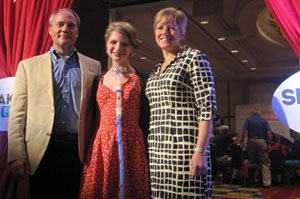
Katie Doderer, with dad, Mark, and mom, Marcy, has a rare medical condition that requires 24-hour use of a ventilator (Photo by Jenny Gold/KHN).
More than 2 million kids in the US are born with multiple chronic illnesses that often require frequent trips to the hospital. Problems include cystic fibrosis, muscular dystrophy and cerebral palsy, among many other diseases. As medicine has advanced, more very sick children survive past infancy, and even thrive.聽
The number of medically complex kids is growing at a rate of about 6 percent a year, according to the Children鈥檚 Hospital Association. And that comes with a heavy price tag for state and federal budgets.聽
Million Dollar Baby
Katie鈥檚 care has been expensive, but her family is in a better position to deal with the challenges than most: Her mom is the CEO of Arkansas Children鈥檚 Hospital.聽
鈥淜atie hit a million [dollars] in her first year of life,鈥� says Marcy Doderer, Katie鈥檚 mother. Katie used to require 24-hour nursing; now the nurse only comes at night, but it still costs almost $75,000 a year, by Marcy鈥檚 estimate. It鈥檚 a service that most private insurance doesn鈥檛 cover. It is, however, paid for by Katie鈥檚 Medicaid coverage鈥攅ven though the family is well off.
鈥淭he stereotypical image that comes to mind is a very poor family with a child on Medicaid,鈥� says Marcy. 鈥淏ut it is important to know that in most states there鈥檚 some sort of program that is there to supplement private health insurance for a truly medically complex child.鈥澛�
The sickest 2 million kids account for about 40 percent of聽聽on children. Many of these children have a combination of private insurance and Medicaid, and it can be challenging to coordinate care and coverage. Marcy Doderer, who until recently was the CEO of the children鈥檚 hospital in San Antonio, Texas, acknowledges that her job gives her family an advantage.聽
鈥淚 know how to navigate the system,鈥� she says. 鈥淚 know how to find ways to get what my child needs that the average family would never know how to do.鈥澛�
Still, Marcy has seen first hand all the ways that the medical system can fall short for patients like Katie. She says Katie鈥檚 care is often scattershot.
鈥淚n our current health system in San Antonio there are no links between the medical records of the different specialists,鈥� Marcy says. 鈥淭here is not a single person other than my husband really who is paying attention to how care is coordinated for a kid like Katie.鈥�
鈥榃hat A Waste鈥�
Katie鈥檚 dad, Mark Doderer, is her main caregiver. He has traveled with her more than 20 times to Chicago to see the doctors who specialize in Katie鈥檚 rare disease. But Katie鈥檚 Medicaid doesn鈥檛 travel with them: The hospital in Chicago doesn鈥檛 accept the Medicaid Katie got from Texas. And that care isn鈥檛 coordinated. Mark says the doctors in San Antonio and Chicago often want to do the same test twice, like an EKG.
鈥淭hey鈥檒l just repeat it, because they want the EKG done according to their rules and that it鈥檚 in their records,鈥� he says. 鈥淲hat a waste.鈥�
Mark remembers a mix up between doctors that ended with Katie being prescribed a medication that interfered with another she was already on. The result could have been fatal. Marcy Doderer says hospitals can do better.
At the Children鈥檚 Hospital San Antonio, Doderer says she tried to use her experience as a mom to improve things by focusing on a child-centered team approach, even hiring special care coordinators in charge of managing care for each of the sickest kids. The Children鈥檚 Hospital Association has been lobbying Congress to help create a special network within Medicaid to coordinate care between hospitals, too.
鈥淥ur hope is to create legislation that would identify these kids in a separate bucket, so to speak, so you can build bridges between the state Medicaid programs to make care more seamless for kids who have to cross state lines,鈥� Doderer says.
Improving the communication between doctors and hospitals to limit repeat tests and unnecessary procedures for medically complex children could save Medicaid $13 billion over 10 years, according to聽聽by CHA. But Matt Salo, who runs the聽, worries that while making care more efficient is a worthy goal, it could come at a price.
鈥淚t鈥檚 important to think about health care spending not as competing for infinite dollars where everyone gets everything they want,鈥� says Salo. 鈥淗ealth care is, unfortunately, a limited pool of funds. So carving out additional dollars for one group may well mean that another group gets less鈥攍ow-income frail seniors or individuals with physical disabilities.鈥�
In her new role running the children鈥檚 hospital in Little Rock, Doderer says she鈥檒l continue her push for better care. For Katie, it means a new school, new friends and a new set of doctors.聽
鈥淪he has challenging days,鈥� Marcy says of Katie. 鈥淚t鈥檚 not easy walking around with a ventilator, and you don鈥檛 get to go swimming or have normal sleepovers with your friends. But she has traveled internationally, she snow-skis, she plays the harp.鈥澛�
Up next? Learning to ride a bicycle, ventilator and all.