
To Schedule A Doc Visit, Get In Line
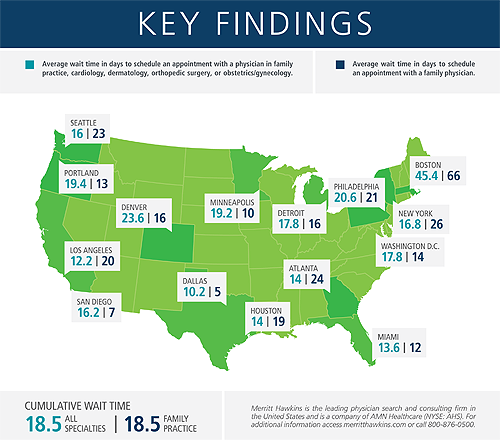
Need to see a doctor? You may have to wait.
A in 15 metropolitan areas across the country, which was聽taken before the health law expanded coverage, found that the average wait time for a new patient to see a physician in five medical specialties was 18.5 days. 聽The longest waits were in , where an average of 72 days to see a dermatologist and 66 days to see a family doctor. The shortest were in Dallas, where the average wait time is 10.2 days for all specialties, and just 5 days to see a family doctor.
鈥淲e have too few providers, which is creating a significant access problem,鈥� says Travis Singleton, senior vice president of in Texas, which conducted the survey. The health care and physician search consulting firm spoke with 1,399 medical offices between June and November 2013 in five different areas of specialization: cardiology, dermatology, obstetrics/gynecology, orthopedic surgery and family practice. Researchers called the practices and asked for the first available appointments for new patients needing routine care, such as a heart check up or a well-woman visit.
The good news is that wait times actually decreased slightly, down from an average of 20.4 days when the survey was last conducted in 2009, and down from 20.9 days in 2004. Singleton attributes the slight improvement to practices employing more midlevel providers like nurse practitioners, better health care IT to help with scheduling and an increase in the number of urgent care centers.
Even Boston, which has eye-popping wait times, has gotten better. The city’s average wait time dropped from nearly 50聽days in 2009 to 45.4聽 days in 2013. That nearly brings it closer to its of about 39 days in 2004 before Massachusetts adopted its version of health care reform.
The bad news is that fewer doctors are accepting Medicaid: An average of 45.7 percent of physicians surveyed take Medicaid coverage, down from 55.4 percent in 2009. Acceptance rates varied widely, however, ranging from 73 percent in Boston to 23 percent . An average of 76 percent of physicians surveyed accept Medicare.
The rates of Medicaid acceptance are likely to prove problematic as more and more Americans sign up for Medicaid under the Affordable Care Act. 鈥淎t the end of the day, it doesn鈥檛 matter how many physicians you have,鈥� says Singleton. 鈥淚f no one will take your insurance, you鈥檙e going to end in the same place, and that鈥檚 probably the ER.鈥� 聽And with more patients covered both by Medicaid and private insurance, he says, wait times are likely to get worse.
But of the MGMA Health Care Consulting Group, which consults with physician practices, says wait times don鈥檛 always increase in proportion to patient volume. As plan deductibles and copays have gone up in recent years, patient volume in outpatient settings have actually declined, he says.
And long wait times can be attributed to many things other than patient volume, he adds, including operators not understanding the scheduling system. 鈥淢ost practices are working diligently to see patients and see them in a timely manner, but there are a lot of moving parts,鈥� he says.
鈥淭he successful practices will figure out new ways and approaches to shortening wait times. This isn鈥檛 going to be acceptable鈥� in the long term, says Hertz.
This post was updated to correct information in the graph about Boston’s overall wait times. The current wait averages聽45.4 days, while it was nearly 50 days in 2009 and 39 days in 2004.


