


PRESQUE ISLE, Maine 鈥� Outside the Mi鈥檏maq Nation鈥檚 health department sits a dome-shaped tent, built by hand from saplings and covered in black canvas. It's one of several sweat lodges on the tribe鈥檚 land, but this one is dedicated to helping people recover from addiction.
Up to 10 people enter the lodge at once. Fire-heated stones 鈥� called grandmothers and grandfathers, for the spirits they represent 鈥� are brought inside. Water is splashed on the stones, and the lodge fills with steam. It feels like a sauna, but hotter. The air is thicker, and it鈥檚 dark. People pray and sing songs. When they leave the lodge, it is said, they reemerge from the mother鈥檚 womb. Cleansed. Reborn.
The experience can be 鈥渁 vital tool鈥� in healing, said Katie Espling, health director for the roughly 2,000-member tribe.
She said patients in recovery have requested sweat lodges for years as a cultural element to complement the counseling and medications the tribe鈥檚 health department . But insurance doesn鈥檛 cover sweat ceremonies, so, until now, the department couldn鈥檛 afford to provide them.
In the past year, the Mi鈥檏maq Nation received more than $150,000 from settlements with companies that made or sold prescription painkillers and were accused of exacerbating the overdose crisis. A third of that money was spent on the sweat lodge.
Health care companies are more than $1.5 billion to hundreds of tribes over 15 years. This windfall is similar to settlements that many of the same companies are paying to state governments, which total about $50 billion.
To some people, the lower payout for tribes corresponds to their smaller population. But some tribal citizens point out that the overdose crisis has had a disproportionate effect on their communities. Native Americans had the highest overdose death rates of any racial group each year from 2020 to 2022. And federal officials say those statistics were likely undercounted by about 34% because Native Americans鈥� race is often misclassified on death certificates.
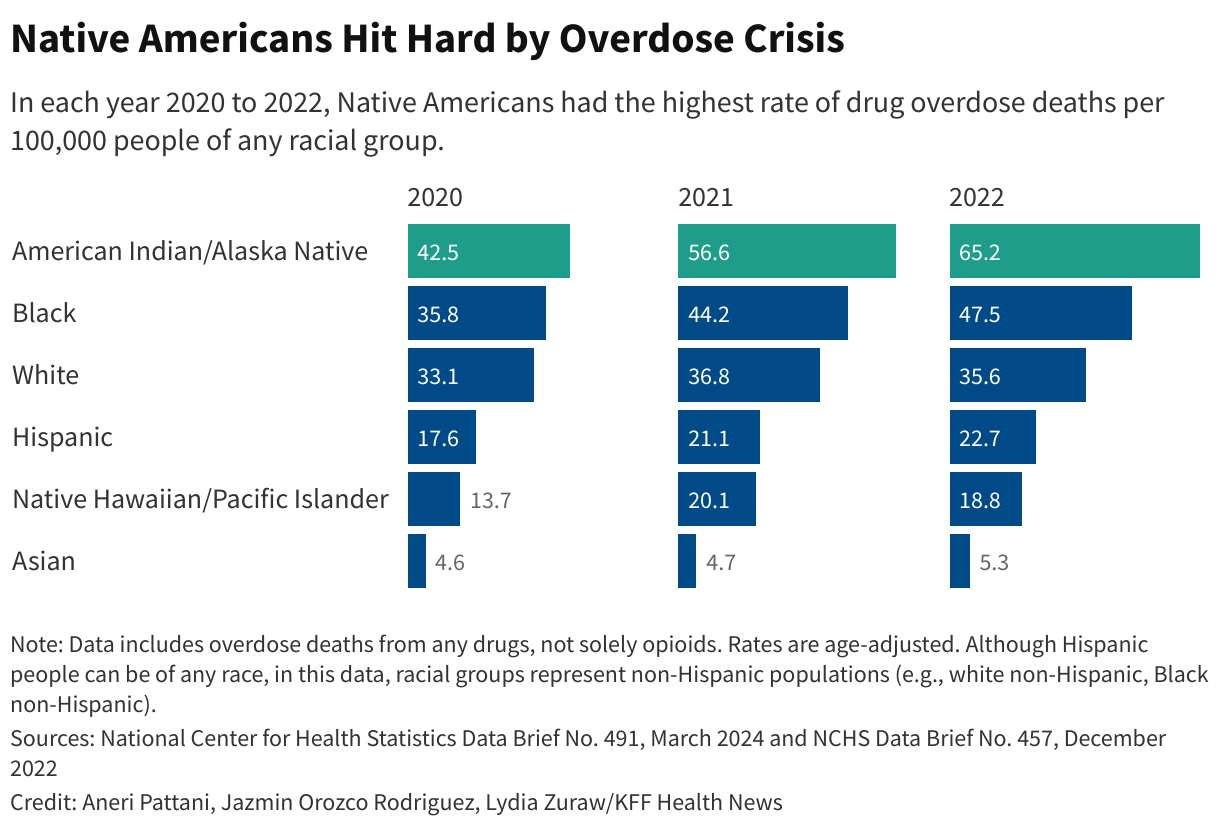
Native Americans Hit Hard by Overdose Crisis
In each year 2020 to 2022, Native Americans had the highest rate of drug overdose deaths per 100,000 people of any racial group.
Note: Data includes overdose deaths from any drugs, not solely opioids. Rates are age-adjusted. Although Hispanic people can be of any race, in this data, racial groups represent non-Hispanic populations (e.g., white non-Hispanic, Black non-Hispanic).
Sources: and
Still, many tribal leaders are grateful for the settlements and the unique way the money can be spent: Unlike the state payments, money sent to tribes can be used for 鈥� anything from sweat lodges and smudging ceremonies to basketmaking and programs that teach tribal languages.
鈥淭o have these dollars to do that, it鈥檚 really been a gift,鈥� said Espling of the Mi'kmaq tribe. 鈥淭his is going to absolutely be fundamental to our patients鈥� well-being鈥� because connecting with their culture is 鈥渨here they鈥檒l really find the deepest healing.鈥�
Public health experts say the underlying cause of addiction in many tribal communities is intergenerational trauma, resulting from centuries of brutal treatment, including broken treaties, land theft, and a government-funded boarding school system that sought to erase the tribes鈥� languages and cultures. Along with a long-running lack of investment in the Indian Health Service, these factors have led to lower life expectancy and higher rates of addiction, suicide, and chronic diseases.
Using settlement money to connect tribal citizens with their traditions and reinvigorate pride in their culture can be a powerful healing tool, said , a researcher with the Johns Hopkins Center for Indigenous Health and a member of the Haida Nation. She for how tribes can consider spending settlement money.
Medley said that having respect for those traditional elements outlined explicitly in the settlements is 鈥渞eally groundbreaking.鈥�
鈥楢 Drop in the Bucket鈥�
Of the 574 federally recognized tribes, more than 300 have received payments so far, totaling more than $371 million, according to , one of three court-appointed directors overseeing the tribal settlements.
Although that sounds like a large sum, it pales in comparison with what the addiction crisis has cost tribes. There are also hundreds of tribes that are excluded from the payments because they aren鈥檛 federally recognized.
鈥淭hese abatement funds are like a drop in the bucket compared to what they鈥檝e spent, compared to what they anticipate spending,鈥� said , a lawyer who represented several tribes in the opioid litigation and a citizen of the Passamaquoddy Tribe. 鈥淎batement is a cheap term when we鈥檙e talking about a crisis that is still engulfing and devastating communities.鈥�
Even leaders of the Navajo Nation 鈥� the largest federally recognized tribe in the United States, which has received $63 million so far 鈥� said the settlements can鈥檛 match the magnitude of the crisis.
鈥淚t鈥檒l do a little dent, but it will only go so far,鈥� said Kim Russell, executive director of the Navajo Department of Health.
The Navajo Nation is trying to stretch the money by using it to improve its overall health system. Officials plan to use the payouts to hire more coding and billing employees for tribe-operated hospitals and clinics. Those workers would help ensure reimbursements keep flowing to the health systems and would help sustain and expand services, including addiction treatment and prevention, Russell said.
Navajo leaders also want to hire more clinicians specializing in substance use treatment, as well as primary care doctors, nurses, and epidemiologists.
鈥淏uilding buildings is not what we want鈥� from the opioid settlement funds, Russell said. 鈥淲e鈥檙e nation-building.鈥�
High Stakes for Small Tribes
Smaller nations like the Poarch Band of Creek Indians in southern Alabama are also strategizing to make settlement money go further.
For the tribe of roughly 2,900 members, that has meant investing $500,000 鈥� most of what it has received so far 鈥� into a statistical modeling platform that its creators say will simulate the opioid crisis, predict which programs will save the most lives, and help local officials decide the most effective use of future settlement cash.
Some recovery advocates have questioned the model鈥檚 value, but the tribe鈥檚 vice chairman, , said it would provide the data and evidence needed to choose among efforts competing for resources, such as recovery housing or peer support specialists. The tribe wants to do both, but realistically, it will have to prioritize.
鈥淚f we can have this model and we put the necessary funds to it and have the support, it'll work for us,鈥� McGhee said. 鈥淚 just feel it in my gut.鈥�


The stakes are high. In smaller communities, each death affects the whole tribe, McGhee said. The loss of one leader marks decades of lost knowledge. The passing of a speaker means further erosion of the Native language.
For Keesha Frye, who oversees the Poarch Band of Creek Indians鈥� tribal court and the sober living facility, using settlement money effectively is personal. 鈥淚t means a lot to me to get this community well because this is where I live and this is where my family lives,鈥� she said.
Erik Lamoreau in Maine also brings personal ties to this work. More than a decade ago, he sold drugs on Mi鈥檏maq lands to support his own addiction.
鈥淚 did harm in this community and it was really important for me to come back and try to right some of those wrongs,鈥� Lamoreau said.
Today, he works for the tribe as a peer recovery coordinator, a new role created with the opioid settlement funds. He uses his experience to connect with others and help them with recovery 鈥� whether that means giving someone a ride to court, working on their r茅sum茅, exercising together at the gym, or hosting a cribbage club, where people play the card game and socialize without alcohol or drugs.
Beginning this month, Lamoreau鈥檚 work will also involve connecting clients who seek cultural elements of recovery to the new sweat lodge service 鈥� an effort he finds promising.
鈥淭he more in tune you are with your culture 鈥� no matter what culture that is 鈥� it connects you to something bigger,鈥� Lamoreau said. 鈥淎nd that鈥檚 really what we look at when we鈥檙e in recovery, when we talk about spiritual connection. It鈥檚 something bigger than you.鈥�
杨贵妃传媒視頻 Health News is a national newsroom that produces in-depth journalism about health issues and is one of the core operating programs at KFF鈥攁n independent source of health policy research, polling, and journalism. Learn more about .