


BALTIMORE — Mary Snyder found out during her pregnancy at her 19-week ultrasound that her baby had ; both of Alice鈥檚 feet were completely turned inward, forming the twisted U-shape typical of clubfoot. 聽
The condition is one of the most common birth defects, affecting about , but that was little comfort to Snyder.
鈥淚t was terrifying,鈥� remembers Snyder. 鈥淚t was very emotional. We did a lot of testing and everything to make sure she was going to be ok, but you never really know until you see them when they鈥檙e born.鈥�
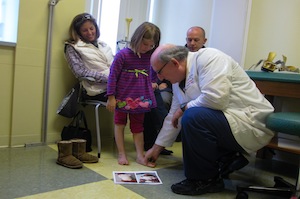
Alice Snyder, 6, and her parents, Ryan and Mary Snyder, meet with Dr. John Herzenberg at Sinai Hospital in Baltimore (Photo by Jenny Gold/KHN).
Just a decade ago, up to 90 percent of babies like Alice were treated with surgery that usually had to be repeated several times, creating a buildup of scar tissue that often left patients with a lifetime of chronic pain, stiffness, arthritis and medical bills. But with the help of a simple, noninvasive solution and an internet campaign led by parents, the course of treatment and likely outcomes have changed completely.
Alice, who is now 6, has a checkup every year with Dr. John Herzenberg, an orthopedic surgeon聽 at Sinai Hospital in Baltimore. Alice happily follows the doctor鈥檚 instructions, walking back and forth across the exam room, then on her tippy toes, and finally with her feet turned out like a duck. 聽
Slow But Steady
To the untrained eye, Alice looks perfectly normal. Her feet are turned out, as if they鈥檇 been that way since birth. She has never had surgery. 聽
Instead, Herzenberg used what鈥檚 called the . The doctor begins by applying a series of full-leg casts, which are changed each week, to slowly turn out the infant鈥檚 flexible feet in a very particular manner.聽 Before the final cast is applied, a small incision is made in the back of the foot to clip a tendon. Then, the child wears a special set of boots connected by a bar at night for a few years to make sure the feet stay in the right position鈥攖hink of it as a retainer worn after braces are removed from teeth.聽 聽
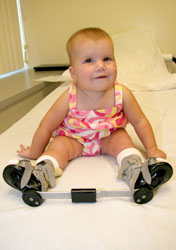
Alice as a baby (Photo by Alvien Lee/Sinai Hospital)
鈥淚n the past, before I learned Ponseti, guaranteed I would literally have had to do a surgical operation to take apart and put together the entire foot,鈥� says Herzenberg, looking at a photo of Alice鈥檚 feet at birth, which formed a bowed U-shape beneath her tiny torso.聽
The casting technique was developed by Dr. Ignacio Ponseti at the University of Iowa in the 1950s.聽 The Spanish physician discovered that if an infant鈥檚 feet were slowly turned out over the first few months of life, the foot could be coaxed into a normal position.聽 聽
Unlike the traditional surgical method, the Ponseti method is pretty much painless, and patients who receive it usually have a complete recovery, with no long-term discomfort. It also for the health care system. Ponseti spent the next 50 tirelessly trying to get other doctors to accept it, but with little success.聽
鈥淧eople were falling over themselves to do fancy invasive surgery, and this one strange old guy who speaks softly with a Spanish accent in Iowa was getting sort of ignored by the drumbeat of people who were in favor of surgery,鈥� says Herzenberg, who is one of the foremost practitioners of the Ponseti Method today.聽
50 Years Later鈥�.
Surgeons are trained to operate, explains Herzenberg, and usually that鈥檚 the way they make money. The Ponseti Method brings in a lot less for orthopedists. For about 50 years, technique mostly stayed in Iowa.
But then something new came along: The internet.聽
When Jennifer Trevillian鈥檚 daughter was born with clubfoot in 2000, the doctors said surgery was inevitable. 鈥淗e started talking about her pending surgery before he physically examined her foot,鈥� Trevillian remembers.
When she got home, Trevillian started researching the condition on her new dial-up connection. There wasn鈥檛 much. But she did find a few other parents talking about another option on iVillage, and a new Yahoo support group called NoSurgery4ClubFoot. A few days later, she was on her way from Michigan to Iowa to see Dr. Ponseti.
鈥淚n the amount of time that we would have just been waiting for her to be big enough to tolerate the anesthesia for the reconstructive surgery she was supposed to have, Dr. Ponseti completely corrected her foot,鈥� says Trevillian.
She joined the small but growing group of parents evangelizing about the Ponseti method online. She built a few websites herself telling her daughter鈥檚 story, and she stayed active on the fast-growing yahoo group. Parents began following each other鈥檚 advice 鈥攃hoosing to abandon doctors who insisted on surgery and often traveling long distances to find a Ponseti practitioner. 聽
鈥淭he way that the clubfoot treatment pendulum has swung is really a classic example of supply and demand鈥� because once parents found out about it, they demanded it for their kids and it really forced the medical industry to rethink the Ponseti method,鈥� says Trevillian. 聽
鈥淐lubfoot is a real prototype for how the internet has changed medicine and how parents have been the driving force in many ways,鈥� says Herzenberg.聽
Today, the Ponseti method is now almost always the treatment of choice for clubfoot, and is recommended by the . When done correctly, 97 percent of kids born with clubfoot never need invasive surgery.


