


WAYNESVILLE, N.C. — In the mountains of Western North Carolina, health insurance Julia Buckner spends hours driving around what she calls “God鈥檚 Country” 鈥� miles and miles of mountains, rivers and winding roads. Her job – and her passion – is to help the rural residents of some of the poorest counties in North Carolina sign up for coverage through the Affordable Care Act.聽
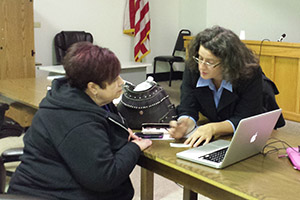
Navigator Julia Buckner helps a consumer sign up for health insurance in the Swain Country courthouse (Photo by Jenny Gold/KHN).
But for nine out of ten of the people she talks with, she says, it seems as if there鈥檚 nothing she can do. They鈥檙e too poor to qualify for affordable health insurance in North Carolina, because they’re in what鈥檚 called 鈥渢he 鈥� They don鈥檛 earn enough to qualify for a subsidy under the health law, and they can鈥檛 get Medicaid because North Carolina is one of the that decided not to expand the program under the health law. The expansion covers childless, low-income adults who previously didn’t qualify for Medicaid.
鈥淚 take someone who鈥檚 working poor, I ask them to come see me, and then I find out that not only are they poor, but they鈥檙e too poor for me to help. It鈥檚 almost as if I wished I hadn鈥檛 seen them,鈥� says Buckner, who grew up in the area.聽
So now, the name of the game is the workaround 鈥� inventive ways that low-income consumers can earn enough to reach the poverty line ($11,500 for a single person) in order to qualify for a a subsidy. Sometimes, Buckner says, people haven鈥檛 thought of all the various things they can count as income, like a woman she spoke with who cleans houses for a living.
“We went through a bunch of questions, like what else could you consider income? And there鈥檚 this light that goes off. ‘Oh! Can I use the ginseng?’ And I said ‘Sure,'” she explains.聽
The woman can earn money selling wild ginseng from her yard, plus some extra money from a few new cleaning clients. That additional income pushes her over the poverty line. She was able to sign up for coverage on the exchange with a hefty subsidy.
Other people may be able to pick up a extra hours at work or count on extra money from odd jobs — taking care of an aging neighbor or babysitting, for example.聽
鈥淔olks are trying to use every source of income, whether it鈥檚 selling tomatoes from their garden, or perhaps they鈥檝e never actually sold the hay off of their field, they鈥檝e just always let their nephew cut it for free,鈥� explains Buckner.
Or they might be able to get coverage under other provisions of the law. About 40 minutes away from Graham County, the local courthouse in Swain County lets Buckner set up shop in their small claims court when it鈥檚 not in session. Wandering around town, she spots a young man with a thick red beard and a flannel shirt, playing banjo in front of the bank.聽
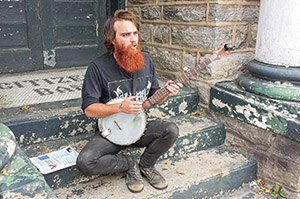
John Martin, a young man who was uninsured, playing banjo in front of a bank in Swain County (Photo by Jenny Gold/KHN).
She waits for a break in his playing and approaches. 鈥淒o you have health insurance?鈥� she asks.聽 鈥淚 do not,鈥� replies John Martin, who adds that he used to have coverage through his mom鈥檚 plan but lost it when he turned 21. Now he works for the railroad, but during the off-season he鈥檚 unemployed. And he earns less than $11,500, which is 100 percent of the federal poverty level for a single adult.聽
But it turns out that he鈥檚 only 24. Bingo. The law allows people under 26 to stay on a parent鈥檚 plan. And it worked. Martin was able to get coverage through his mom and is now insured.
Even for those a little older, there might still be options.
At a church in nearby Franklin, Chuck Cantley stopped by a presentation about the health law after receiving a letter from Blue Cross Blue Shield explaining that the plan he was getting for $240 per month would soon cost him $1,100.
鈥淲ell, I can鈥檛 do that,鈥� said Cantley. 鈥淚鈥檝e got to find another option. Either that or I won鈥檛 have insurance.”
Cantley, 62, is retired but was waiting to collect Social Security until he was 66, hoping to get a higher monthly rate. But he needs health coverage now. So he applied for Social Security early, which pushed him and his wife up to the poverty level. He qualified for a big subsidy and signed up for coverage on the health insurance exchange.
Success stories like Cantley and Martin are the minority, but they give Buckner hope.
鈥淭he folks that have been able to sign up, they are ecstatic,” she says.聽 “And as long as we keep hearing success stories, that energy and excitement are going to grow.”


