


SONOMA, Calif. — Even when fire threatened her home in downtown Sonoma, the elderly woman inside who was suffering from late-stage cancer refused to leave.
She had returned home to die in peace, after all. Smoke was everywhere. Her caretaker begged her to heed the mandatory evacuation order.
Another woman on the outskirts of town, who was also home receiving hospice care, said all the young people telling her to get out were just “making hay†over nothing.
“They didn’t want to leave because they wanted to die in their home,†said Karna Dawson, a social worker with . “They didn’t want to leave because they didn’t realize the severity of the problem. They didn’t want to leave because they were stubborn.â€
While the worst wildfires in state history were ravaging California’s Wine Country earlier this month, Hospice by the Bay and other hospice providers had to do something that seemingly contradicted their mission: They had to persuade dozens of their terminally ill clients to evacuate the homes they had hoped would serve as quiet, familiar havens in their final days.
“Some people were feeling like if they were going to die, they wanted to die in their house, and [were] not really thinking that through very clearly,†Dawson said. “We’re not talking about dying of your cancer. We’re talking about dying in a fire. And those are two very different deaths.â€
When the fires broke out on Oct. 8, nurses and staff with Hospice by the Bay were providing home care, pain management and spiritual counseling to 108 patients in Napa and Sonoma counties. Nearly half of those patients had to be evacuated.
Under federal rules, hospice agencies that receive payment from Medicare, the publicly funded health insurance program for older Americans, are required to have a disaster plan in place, including how to get bed-bound patients out of their homes.
Robin Finkelstein, who runs Heartland Hospice Care in Santa Rosa and San Rafael, had to evacuate her own home in Santa Rosa on the day the fires first began but came to work every day that week to make sure her patients were settled, and in many cases, resettled multiple times. About 40 percent of her 150 patients were moved.
Patients and their family members were not available to comment for this story.
“There were mandatory evacuations that changed each and every day,†Finkelstein said. “We’ve had patients who evacuated and went back home, then were evacuated again.â€
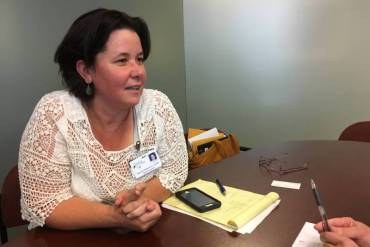
Karna Dawson helped lead the effort to make sure patients getting care from Hospice by the Bay were safely evacuated during the North Bay wildfires. (April Dembosky/KQED)
Dawson, of Hospice by the Bay, was implementing the disaster plan by 4 a.m. Oct. 9, as fires exploded across the area. She sat huddled over her laptop at her home in Petaluma, wearing her grey pajamas and tattered pink bathrobe. She was talking on two phones at once, trying to locate all of her agency’s hospice patients and ordering ambulances for them when necessary.
In some cases, once the ambulances retrieved patients, they just drove away from the fires to get to safety, Dawson said. The hospice staff had to figure out where they ended up.
“It was just a moving target of where people were going and where they were landing,†said Wendy Ranzau, Hospice by the Bay’s chief operating officer.
For many patients, the first stop was one of more than 20 Red Cross evacuation shelters in Sonoma and Napa counties. This required hospice staff to adjust their goals, while still trying to fulfill their mission to provide patients an opportunity to die with dignity.
“Our priority was to make sure that we did not have a patient die in an evacuation center,†Ranzau said. “So even if they can’t die at home, they’re going to die someplace other than a cot in an auditorium.â€
Within two days, Hospice by the Bay had safely relocated all of its patients, even ones who had temporarily landed in shelters. Some patients went to live with relatives across the state, from Citrus Heights near Sacramento to Santa Barbara down south.
Some were resettled in assisted living facilities or nursing homes, with Hospice by the Bay dipping into its reserves to pay the fees — costs the Medicare program does not require hospice agencies to cover under their disaster plans.
A couple of patients actually found the shelters surprisingly comfortable.
“There was one gentleman who didn’t want to leave the shelter. He had lived alone and he was loving the attention. He thought it was great,†Dawson said. “It took us 24 hours and the medics saying, ‘You can’t really stay here.'”
Several of the hospice’s patients died in a strange place away from home during the first week of the fire. By the second week, about 70 percent of patients returned home.
Several Heartland Hospice patients also passed away in unfamiliar settings. Finkelstein was able to return to her home — the fire had come within 50 yards of her property.
Ranzau predicts some patients will never return because their homes burned down, there’s still no power or they’re too medically fragile to survive another move. One patient lost 5 pounds in the week after the fire started, she said.
“When you think about hospice, our median length of stay is about three weeks,†Ranzau said. “A week in the life of a hospice patient, unfortunately, is a third of their time on hospice. So it just doesn’t make sense. You know, is a trauma of transferring again too much for them?â€
That means some of these patients won’t have the death they planned, making them tragic players in the overall trend in dying: 70 percent of Californians say they want to die at home, but only 32 percent do.
Now the Sonoma woman with cancer, whose dying wish was to spend her final days in her own house, will die in a nursing home.
“She’s OK. She’s OK,†Dawson said uncertainly, when asked about her status a week after the fires began. “She’s adjusting.â€
Finkelstein said her patients are traumatized.
“They have real losses that they’re dealing with and changes,†she said.
“Psychologically, there’s a high level of distress. And not just patients. It’s their families, and all of our employees.â€
For most hospice patients, there just isn’t enough time to adapt to all the changes.
“I, or you, can have six months or a year to process this and think it through,†Dawson said. “We can have another fall that’s pretty and recover. Where they might not, and likely won’t.â€


